Who knew our favorite Star Wars characters were using Facebook?
Four more Star Wars Facebook status threads can be found here (CollegeHumor.com).
Archive for November, 2009
Who knew our favorite Star Wars characters were using Facebook?
Four more Star Wars Facebook status threads can be found here (CollegeHumor.com).
Your inciting incident. You know – your story catalyst; your protagonist’s call to action / adventure.
As Robert McGee writes in his fantastic book, Story: Substance, Structure, Style and The Principles of Screenwriting:
The INCITING INCIDENT radically upsets the balance of forces in the protagonist’s life.
It’s that event or circumstance that shakes up your protagonist’s world and sets your main story in motion. It usually occurs within the first 15 pages of your script.
Can you pinpoint it in your script?
“Of course I can!” you scoff.
I know it may sound like an easy question, but apparently it’s not. I’ve read several scripts lately where an event occurred early on, that I’m sure the writer believed was the inciting incident, but was really just part of the set up.
The writers forgot one critical thing about the inciting incident. To quote McGee again:
The protagonist must react to the Inciting Incident
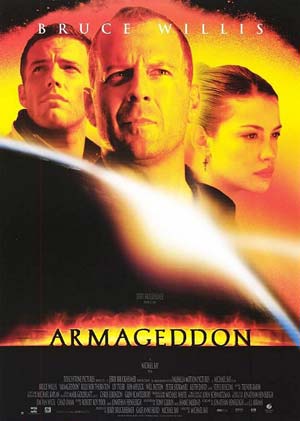
Let’s take Armageddon, for instance. When the first meteors destroy the Space Shuttle and strike the earth — is that the inciting incident? Nope.
What about when Truman (Billy Bob Thornton), at NASA, discovers the implications of the Texas-sized asteroid that’s flying toward the Earth? Nope.
That’s all set up.
The inciting incident occurs when the protagonist, Harry Stamper (Bruce Willis), is summoned to NASA from his oil rig. That’s when his world changes.
Isn’t this all just a bunch of dirty rotten semantics?
Who cares what you call it, as long as it’s in there somewhere, right?
Wrong.
The problem is that your first audience (i.e. the script reader) expects it early in the script. Back when 120 page scripts were standard, the inciting incident was expected by page 15. These days page 12 is typical, and there are many producers and execs that now expect it by page 10!
In reality, it’s not about the specific page count. But page counts do coincide with the leeway those reading your script are typically willing to give you.
The reality is, if your inciting incident doesn’t occur until page 30 (like Rocky), you had better have some terrifically entertaining stuff to read while we wait until then. In Rocky, we have the romance between Adrian (Talia Shire) and Rocky (Sylvester Stallone) to tide us over until Rocky gets his big shot at fighting the champ.
Note: This movie is a RARE example. In today’s market, if you put your inciting incident on page 30, your script will likely go down for the count.
That’s why it’s important to know your inciting incident
If you think you’ve given it to the reader on page 12 (e.g. the scary new crime boss comes to town), but it really doesn’t happen until page 25 (when the crime boss’s son kills the protagonist’s grandma at the Circle K) you may be scriptwrecked.
Make sure you know your true inciting incident. The further out it’s located from page 12, the more challenging it becomes to hold and engage your reader. And that’s what it’s really all about at this stage.
First, what are they?
Parentheticals, or actor/character directions, or “wrylies,” are those little descriptions that sometimes appear after a character’s name, in dialogue blocks, to spell out tone, intent or action.
In the poorly written example below (see Rule #1), the parentheticals are “(breathlessly)” and “(confused)”:
The Loyal Squire bursts through the door. Collapses on the ground. Pulls a bloodied envelope from his pocket.
LOYAL SQUIRE
(breathlessly)
I may not live... to see tomorrow my liege... But I die knowing... that I have served thee well.
KING
(confused)
I’m sorry. Who are you?
1. Don’t use parentheticals when it’s redundant or obvious
It’s a common mistake to use parentheticals in places where the emotion or intent of the dialogue is already obvious (my example above, for instance).
Many actors dislike parentheticals — it’s their job to interpret the emotion, etc. of the scene based on the dialogue provided. So it’s very important to use them sparingly for emotional cues, and only when it would otherwise be unclear…
2. Use parentheticals to avoid confusion
Take the following dialogue, for example:
GRANNY
How did you like my stew? It’s an old family recipe.
BILL
I hated it.
That’s very different than the following (especially when developing a character):
GRANNY
How did you like my stew? It’s an old family recipe.
BILL
(sarcastically)
I hated it.
3. Don’t use parentheticals to direct minor actions
Similar to Rule #1 (where you’re needlessly directing an actor’s emotions), it’s also a faux pas to overuse them for an actor’s actions.
Example of POOR usage:
DOUG
(index finger massages his right temple)
There must be a way out of here. We have to think.
ELANOR
(purses lip)
I can’t come up with anything.
DOUG
(scratching neck)
Have you tried opening the door?
ELANOR
(shaking head)
No, not yet.
Leave the decisions of those minor actions up to the actor. In the example above, all of the parentheticals should be removed.
Note: If your character has a specific quirk, that’s pivotal to your story, you have a bit more leeway in this regard. But even then, you may be better off including such mannerisms in a line of description.
4. Use parentheticals for quick, significant actions
Often times, you can save several lines by slipping quick and significant actions into the dialogue block. And since some execs only read the dialogue blocks of a script to save time, this practice can even provide some much-needed clarity.
Example of GOOD usage:
GARY
Son of a bitch. You got blood on my shirt!
(kicks the body)
And now my shoe!
5. Parentheticals should never come at the end of a dialogue block
Example of INCORRECT usage:
SCOTT
I told you not to disturb me!
(throws pen at the door)
If the action follows the dialogue, simply pull it out and make it a separate line of description:
SCOTT
I told you not to disturb me!
He throws his pen at the door. It rebounds. Hits him in the eye.
6. Don’t use parentheticals for the actions of a different character
While one actor is speaking, you can’t describe another actor’s actions.
Example of INCORRECT usage:
PETE
There are ninjas all over the place!
(Bruno steps to the window)
What are we gonna do man?
Instead, you would use:
PETE
There are ninjas all over the place!
Bruno steps to the window. Stares bug-eyed.
PETE
What are we gonna do man?!
7. Don’t use parentheticals for sounds or camera directions
Example of INCORRECT usage:
FRED
(WIND HOWLS)
We need to get to that house on the hill!
SHAGGY
(steps INTO FRAME)
Like, you mean that creepy one everyone said was haunted?!
Instead you would write something like:
The WIND HOWLS. Whips at the group’s hair and clothes.
FRED
We need to get to that house on the hill!
SHAGGY
Like, you mean that creepy one everyone said was haunted?!
I left out the “steps INTO FRAME” part. Don’t specify camera directions (in your spec script) unless they’re critical to the comprehension of your scene. Leave that up to the director. (See The 5 key differences between spec and shooting scripts)
8. Don’t capitalize the first letter of parentheticals
Example or INCORRECT usage:
BRAD
(Gritting his teeth)
I couldn’t be happier.
Example of CORRECT usage:
BRAD
(gritting his teeth)
I couldn’t be happier.
9. Use correct punctuation in parentheticals
In those rare cases where you need to specify multiple actions in your parenthetical, don’t use periods, dashes or ellipses.
Example of INCORRECT usage:
WOLFGANG
(looks up from clipboard... smiles -- waves them through with gun.)
Don’t worry. I will not waste my time with you.
First of all, that’s a lot to put in the parenthetical. The first two parts, if not all the parts, should probably have been written as scene description. But for purposes of this exercise, semi-colons are the answer…
Example of CORRECT usage:
WOLFGANG
(looks up from clipboard; smiles; waves them through with gun)
Don’t worry. I will not waste my time with you.
10. Don’t use a pronoun to start the parenthetical
Example of INCORRECT usage:
DAVE
(he winks at Betty)
Sure Sarah, I’ve always thought you were the prettiest.
Instead, you would simply write:
DAVE
(winks at Betty)
Sure Sarah, I’ve always thought you were the prettiest.
For an expanded investigation of the correct way to use parentheticals, I highly recommend the following Amazon books:
Caption Contest
Recently a contest was held to come up with a caption for the following image from Terry Border’s new book: Bent Objects: The Secret Life of Everyday Things

There were the standard lines and puns submitted:
“We need to stop getting fried so early in the day.”
“I’d like to suggest a toast. . .”
“Keeping this relationship secret from Toast was eggs-asperating.”
But the winner, utilized the power of story to brilliant comedic effect, to win top honors.
“Quietly, Coffee watched as they drank her offspring. Confident in the knowledge that neither of them would survive the morning.”
High stakes, conflict, clear primal motivations of the protagonist — all there in two sentences!
As screenwriters we must acknowledge and utilize these fundamental tools of effective storytelling. Are they present in your script?
Original link: Neatorama
This article features the following item:
Some Definitions
A spec script is a screenplay that’s written “on speculation.” That is, you, the screenwriter, write the script without any development contract or promise of payment in place, in the hopes of getting it optioned, sold, or gaining representation by an agent. It’s how most screenwriters break into the industry.
But the spec script will undergo many changes between the time it’s first optioned or sold, and the time shooting begins for the movie. That leads us to…
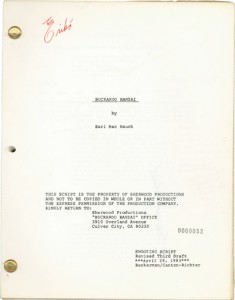
A shooting script — a script that has been vetted, changed, rewritten and is now being used as the blueprint for filming the movie. It’s a different animal than the original spec, in a few fundamental ways.
It’s important to know the difference
Often times screenwriters pick up bad habits from reading shooting scripts available online.
It’s therefore very important, if you’re a new screenwriter submitting a spec script for review, that you understand the differences between the two formats.
1. The Title Page
A spec script should have the title of the movie, “written by,” the author or author’s names, and some contact information (for author or agent). WGA notification is optional.
A shooting script may have, in addition to the above, multiple subsequent writers, studio or producer contact information, draft or revision dates, and copyright notices. So stay away from these things in your spec.
If you don’t know how to correctly format your title page (or script), or even if you think you do, I highly recommend this book:
The Hollywood Standard: The Complete and Authoritative Guide to Script Format and Style by Christopher Riley
You never get a second chance to make a first impression.
2. Scene Numbers
Spec scripts should not have scene numbers.
So if you’re using them as some sort of cool tool to gauge the length of your script, while writing it, make sure you remove them before submitting your script to anyone.
3. Title Sequences
Spec scripts should avoid any reference to opening credits or title sequences. Screenwriters should just focus on crafting the best opening scene they can. Even if you think your concept for opening titles is wicked brilliant, it may brand you as an amateur if you incorporate such a sequence into your spec1.
Shooting scripts can contain title sequences (or at least reference their location) because at that point, the script is finalized and typically the Director knows how everything is going to play out. The guys that look after the title sequences for films are masters of their craft. They won’t be left floundering if you don’t “leave a spot” for the opening titles in your screenplay.
4. Camera Direction
In spec scripts it’s never a good idea to include camera directions (PAN, DOLLY, TILT UP, ZOOM IN ON, CRANE UP, etc.). It’s the Director’s job to interpret your screenplay and come up with their own shots.
It is okay, however, to craft a scene that implies the camera direction — that directs the mind’s-eye of the reader. Just don’t specify a camera shot in your spec, unless it’s absolutely integral to your vision and pivotal to your movie.
Example:
CAMERA TRACKS Bella as she plummets toward the raging ocean.
Instead, write:
Bella plummets toward the raging ocean.
The Director will get it, without your telling him how to film it.
5. The Writing Craft
Often times the shooting script will not be as well written as the spec script. The very nature of breaking scenes up into specific shots can often compromise the writing quality of the original script. Having already been sold on the movie’s merits, scenes may be written, or rewritten for functionality over form, speed over eloquence. Typos may even sneak in.
But that doesn’t mean that the original spec script wasn’t a flawless work of art. It’s not okay to point to errors or poor writing in shooting scripts and say, “Well, if they did that in their script, I can do it in mine.” No can’t. You still have to sell your screenplay.
Also keep in mind that Screenwriter/Directors sometimes write screenplays for themselves. In these cases they tend to include more camera direction and different language — even in “spec scripts” — than they would normally have used.
Bottom Line
Always make your spec script the best it can be. Thank goodness we live in an age where a multitude of scripts are available to us with the click of a mouse, to learn from. Just be wary of picking up bad habits from shooting scripts.
If you can choose between versions of scripts online, take a look at the earlier versions as well. They may be truer to the original spec.