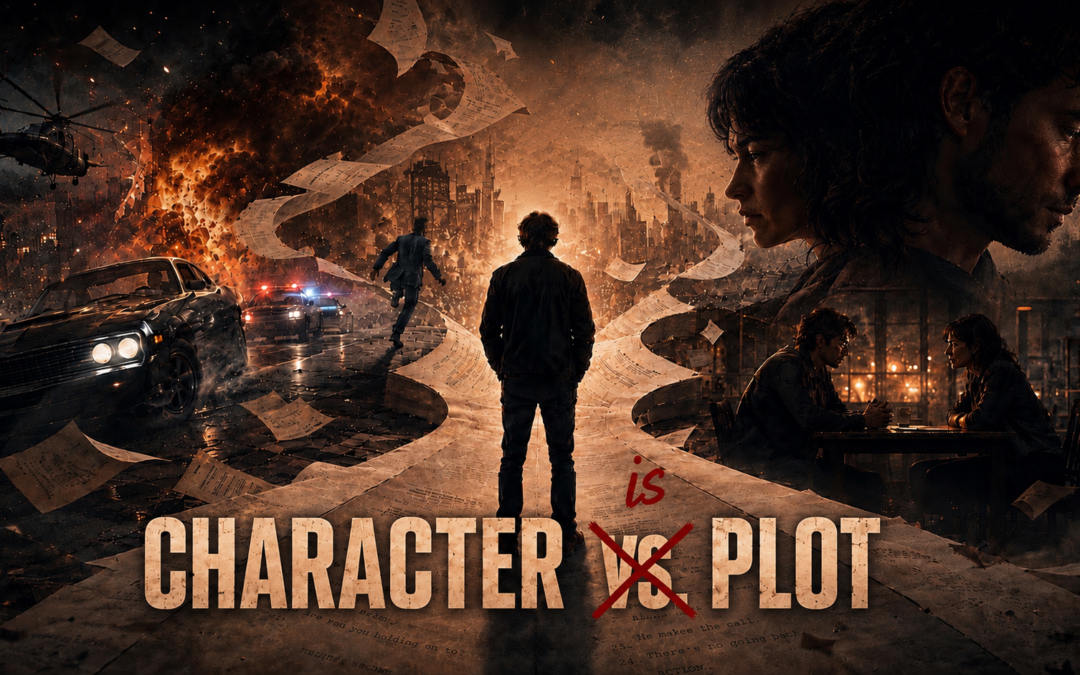
Spend enough time around screenwriters and you’ll inevitably hear someone ask: “Is it character-driven or plot-driven?”
It’s one of those questions that’s been repeated so often that many writers simply accept the premise.
I don’t.
In fact, I’d argue that the distinction doesn’t really exist.
Character is Plot
French philosopher Jean-Paul Sartre famously argued that we are defined not by what we say or believe, but by what we do. Our choices create our identity.
Oddly enough, one of the best cinematic summaries of this idea doesn’t come from philosophy at all. It comes from Total Recall.
As Kuato tells Douglas Quaid:
“A man is defined by his actions, not his memory.”
Whether you’re quoting Sartre or a mutant resistance leader living in another man’s abdomen, the point is the same.
Character is revealed through action.
Not biography. Not personality tests. Not a tragic backstory. Action.
If that’s true—and I believe it is—then character and plot are inseparable.
After all, what is plot except a series of actions and the consequences that follow?
So Why Does the Distinction Exist?
Because we’re usually talking about something else entirely.
When people call a movie “plot-driven,” what they often mean is that the external events are the primary source of entertainment.
The car chases… The explosions… The elaborate heists… The impossible escapes…
The set pieces themselves are exciting.
When they call a movie “character-driven,” they’re usually saying that the most compelling moments aren’t the explosions.
They’re the decisions… The relationships… The moral compromises… The emotional fallout…
The audience is less interested in what happens than in how the characters respond to what happens.
That’s a very different conversation.
The Difference Isn’t Character
It’s consequences.
Every screenplay asks the same basic question: What happens next?
The answer always comes from character.
A decision is made. Someone acts. Something changes. New consequences emerge. Repeat.
The real difference lies in the type of consequences the story emphasizes.
In a character-focused drama, consequences tend to be emotional.
- A marriage falls apart.
- A friendship is destroyed.
- A lie damages someone’s identity.
- A parent loses the trust of a child.
The stakes are internal.
In an action movie, the consequences tend to be physical.
- The bomb explodes.
- The villain escapes.
- The city is attacked.
- The hero survives—or doesn’t.
The stakes are external.
But both stories are still driven by characters making choices.
Stop Choosing Sides
I’ve occasionally seen new writers ask whether they should write “character-driven” or “plot-driven” scripts. That’s like asking whether you should write a comedy that’s funny or a thriller that’s suspenseful. You’re choosing between categories that were never actually opposites.
The better question is:
What kind of consequences does your story care about most?
If you’re writing a courtroom drama, your audience probably isn’t waiting for a helicopter chase.
If you’re writing a summer action blockbuster, they probably aren’t hoping for twenty uninterrupted minutes of relationship counseling.
Different genres emphasize different kinds of conflict. That’s all.
Write Great Characters. Then Put Them Through Hell.
Whether your protagonist is saving a marriage or saving the world, the same principle applies. Interesting people making meaningful decisions under pressure create interesting stories.
Everything else is just genre.
So the next time someone asks whether your screenplay is character-driven or plot-driven, smile politely. Then tell them it’s driven by the only thing stories have ever truly been driven by:
People making choices.